

Legacy Machine Monitoring: Sensors, PLC Connections & Data Limits
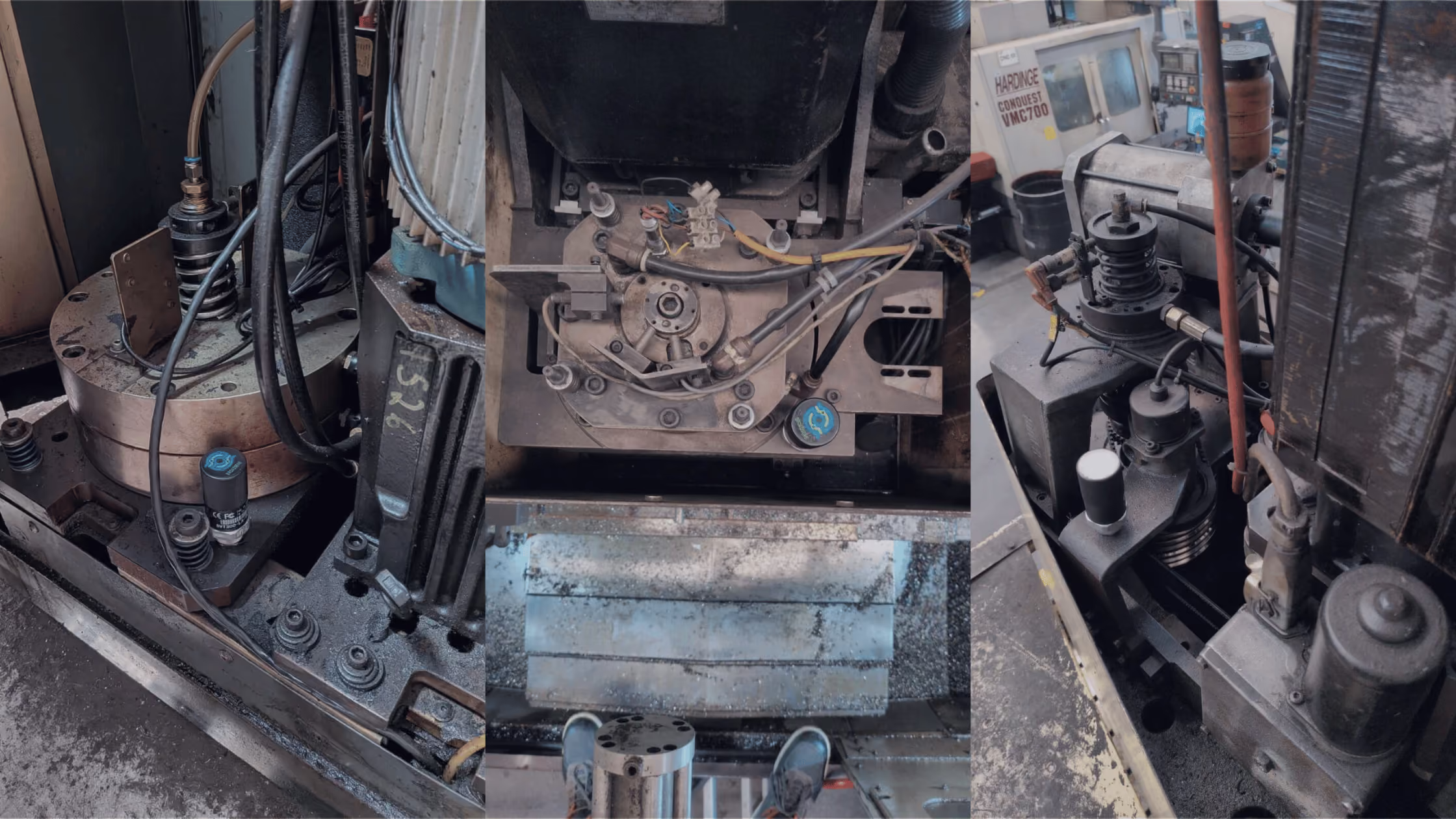
Legacy machine monitoring collects useful production data from equipment that may lack a modern network interface or accessible controller information. External sensors, digital outputs, and supported controller connections offer different paths. The right choice depends on the measurement required, available signals, installation access, and the ability to validate the resulting data.
An older machine can contribute to a connected production view without being replaced. Its age alone does not determine what can be measured. Start with the operating question: do you need run and idle time, completed cycles, part counts, process values, or the inputs for complete OEE? This guide helps a production and technical team map those requirements to a practical connection plan.
In this guide
- Define the required measurements
- Compare connection methods
- Build a machine inventory
- Validate a representative pilot
- Evaluate SensFlo for a mixed fleet
Define the measurements before selecting a connection
The Machine Monitoring Guide introduces the relationship between production signals and operational decisions. For legacy equipment, separating the signal from the desired metric is particularly useful. An activity sensor can show a repeatable operating pattern; additional evidence may be required to establish units produced or first pass quality.
| Required measurement | Evidence needed | Important limitation |
|---|---|---|
| Run, idle, and stop time | Signal associated with defined productive states | An energized or vibrating machine may be in setup or standby |
| Cycle time | Repeatable cycle start or completion event | Signal must distinguish separate cycles at the required rate |
| Total parts | Validated count and units produced per cycle | One cycle may make multiple parts or produce no accepted output |
| Downtime reason | Alarm, process context, or confirmed operator entry | A stop signal alone may not explain the cause |
| Process measurement | Suitable sensor or accessible controller variable | Units, range, sample rate, and calibration must fit the question |
| Complete OEE | Schedule, run time, ideal rate, total count, and good count | Machine activity alone does not establish all factors |
For example, a four cavity press completing 100 shots can produce 400 pieces when all cavities are active. Quality still requires a record of which pieces passed first inspection. The OEE calculation framework explains how to keep shots, cavities, pieces, and ideal cycle time consistent.
Compare legacy equipment connection methods
External sensors for equipment without readable data
External sensing can detect a physical signature such as vibration, motion, proximity, or changing load. It is worth assessing when controller access is unavailable or an initial project focuses on utilization and stop visibility. Installation requirements depend on the device, mounting location, environment, and signal being measured.
Validate the signature through real operating conditions. A spindle can rotate during setup; a hydraulic pump or heater can stay active while production waits. Adjacent equipment can affect vibration readings. If productive and nonproductive states overlap, revise the sensing approach or add a second source of context.
Digital I/O and cycle outputs
An accessible run contact, cycle complete pulse, relay output, or existing sensor can provide a direct event associated with the machine sequence. Before using it, establish the signal’s voltage, isolation requirements, pulse duration, meaning, and behavior during resets or manual operation. Qualified personnel should assess electrical access and any required installation work.
A shot complete signal can provide a shot count; active cavities and quality disposition determine how that becomes a good part count. A cycle signal on a CNC may include multiple parts or repeated program sections. Validate the count against observed output before assigning a units produced label.
Controller and PLC connections
Older equipment may already expose useful variables through a controller interface or a gateway. Confirm model, firmware, enabled options, protocol, access permissions, and available data. The industrial protocols guide explains the wider connectivity landscape.
The OPC Foundation describes OPC UA information modeling and security capabilities. The Modbus Organization publishes protocol and implementation specifications. A protocol name provides a starting point; the exposed variables and configuration determine what the specific machine can supply.
Use the agreed read access and polling or subscription approach for the monitoring project. Establish network ownership, account permissions, and the impact of any adapter before commissioning. An Ethernet port by itself does not guarantee a supported production data interface.
Gateways and mixed connection methods
A gateway can collect or forward selected machine and sensor information, depending on its interfaces and configuration. It does not create a missing quality record or make an ambiguous signal precise. Confirm how records are timestamped, what occurs during a connection loss, and whether buffering and recovery are supported in the selected setup.
| Machine situation | Path to assess | Acceptance question |
|---|---|---|
| No accessible digital interface | External sensing matched to the operating signature | Can productive activity be distinguished from setup and standby? |
| Existing cycle or state output | Compatible digital I/O or pulse capture | Does the event reliably represent the required cycle or state? |
| Readable controller variables | Supported protocol or appropriate adapter | Are required variables available with approved access? |
| Required process variable unavailable | Additional suitable sensor or another verified source | Does the measurement meet the range and accuracy requirement? |
| Fleet with several machine generations | Combination of validated connection paths | Are definitions and units comparable across assets? |
Build a machine inventory that supports a useful quote
Create one record per asset, including older auxiliary equipment that constrains the line. Ask operations, maintenance, and IT or OT to contribute the information they own. Unknown fields can be identified for an equipment survey rather than filled with assumptions.
- Machine identity: asset ID, make, model, approximate year, controller model, and firmware where known.
- Production requirements: run states, cycle rate, parts per cycle, product changes, and quality data source.
- Available interfaces: readable protocols, accessible I/O, cycle outputs, and existing sensors.
- Installation conditions: mounting locations, access restrictions, power, environment, and permitted work windows.
- Network and data requirements: approved connectivity, access roles, storage expectations, and outage handling.
- Pilot criteria: required measurements, observation period, acceptable error, and approval owner.
This inventory separates technical compatibility from economic value. A readable alarm history may be valuable on a frequent delivery constraint. A simpler state signal may answer the first question on a lightly used auxiliary asset. Prioritize the data that supports an actual production decision.
Keep installation and commissioning milestones separate
Physical installation is one milestone. Configuration establishes equipment identities, schedules, state rules, rates, counters, and reporting access. Validation checks whether the measurements match the machine. Operator onboarding establishes reason capture and the daily review process. Plan and price these activities explicitly when comparing deployment promises.
Confirm installation responsibilities for the selected method. Mounting an external device and accessing an electrical panel involve different work. Review any equipment builder restrictions and required maintenance support before agreeing on the installation window.
Validate a representative legacy equipment pilot
Select equipment that represents the fleet’s different connection challenges: for example, an older press with a cycle output, a CNC with accessible controller data, and an auxiliary asset requiring external sensing. Begin with the smallest group that can test the proposed methods and an operational priority.
- Observe producing, standby, setup, stopped, and restart conditions and record expected states.
- Compare reported state durations with observed activity for representative jobs and shifts.
- Reconcile cycles and parts with independent counts, including cavity changes and counter resets.
- Verify units and calibration for any process measurements required by the project.
- Test approved connection interruptions and inspect gap reporting and data recovery behavior.
- Document unresolved limits and approve each measurement before extending it to more assets.
Set numerical acceptance criteria appropriate to the decision. These might include acceptable state duration error, count discrepancy, and data coverage over the observed window. A utilization project and a fast cycle scrap analysis can require different tolerances. Agreement before installation makes the pilot review more objective.
A practical example of a mixed equipment plan
Consider a hypothetical shop with an older hydraulic press, a networked CNC, and a conveyor. The press has a verified cycle complete output, the CNC exposes approved execution and count variables, and the conveyor requires a validated activity sensor. The three assets can contribute to a shared report while retaining distinct source definitions.
The report should identify which assets have validated counts and which provide activity only. Good output and schedules must still be supplied before calculating complete OEE. This prevents a common reporting error: treating every connected asset as though it supplies the same depth of information.
Evaluate SensFlo for a mixed legacy and modern fleet
SensFlo FloControl™ documents support for sensor signals, analog and digital inputs, and protocols including MTConnect, OPC UA, and Modbus, with direct PLC mapping where available. Its published connectivity options include Wi-Fi, Ethernet, and cellular. Suitability and available measurements must be confirmed for the equipment and proposed configuration.
For equipment needing business context, confirm the source of schedules, jobs, operators, and quality records, and how they will be associated with machine events. An ERP connection and a machine data connection serve different purposes. Review the actual integration scope and responsibilities in the proposal.
The True Precision Machining success story describes starting with machine state detection and adding production context through ProShop ERP. It provides a useful example of staged deployment; it does not establish identical compatibility or results for another machine fleet.
Compare total project cost across hardware, connectivity, electrical or controller work, configuration, software, support, and future machine changes. Estimate recovered capacity only where the monitored equipment constrains output or creates avoidable cost. The financial case improves when the required data has a clear owner and a practical response workflow.
Continue to the automated downtime tracking guide to define stop capture, or the machine monitoring buyer’s guide to compare platforms. Review SensFlo pricing for current plan scope and share your equipment inventory with SensFlo to assess the required connection paths.
Frequently Asked Questions
Can older machines be monitored without a modern PLC?
Often, useful production activity or cycle information can be collected through suitable external sensing or existing outputs. The method must be assessed against the actual equipment and required measurement. Age alone does not determine compatibility.
Do legacy machines need OPC UA to be monitored?
No. OPC UA is one possible controller interface. Other paths include supported alternative protocols, digital signals, cycle outputs, and external sensing. Confirm which path supplies the required data for each asset.
Can a current or vibration sensor measure complete OEE?
Such sensors can support activity and stop detection when the operating signature is validated. Complete OEE also requires planned production time, an ideal rate, total output, and good output. Additional sources may be needed for counts and quality.
Is a cycle count the same as a part count?
Only when one cycle reliably produces one part. Molding shots, multicavity tooling, and CNC programs can produce multiple parts per cycle. Define units per cycle and reconcile the resulting count with actual output.
How long does legacy machine monitoring installation take?
The time depends on the selected sensing or connection method, equipment access, networking, and configuration. Separate physical installation from data mapping, operator onboarding, and measurement validation when agreeing on the deployment schedule.
Can one monitoring platform use different connection methods?
A mixed fleet can use several supported methods. Confirm that the platform can combine the chosen sources and that state definitions, units, timestamps, and data quality are consistent enough for the intended reports.
You might also like...



Talk to us
Let us take your company to the next level. Let’s have a chat and find out how we can help you.

