

How to Prevent Production Delays with Real Time Machine Data
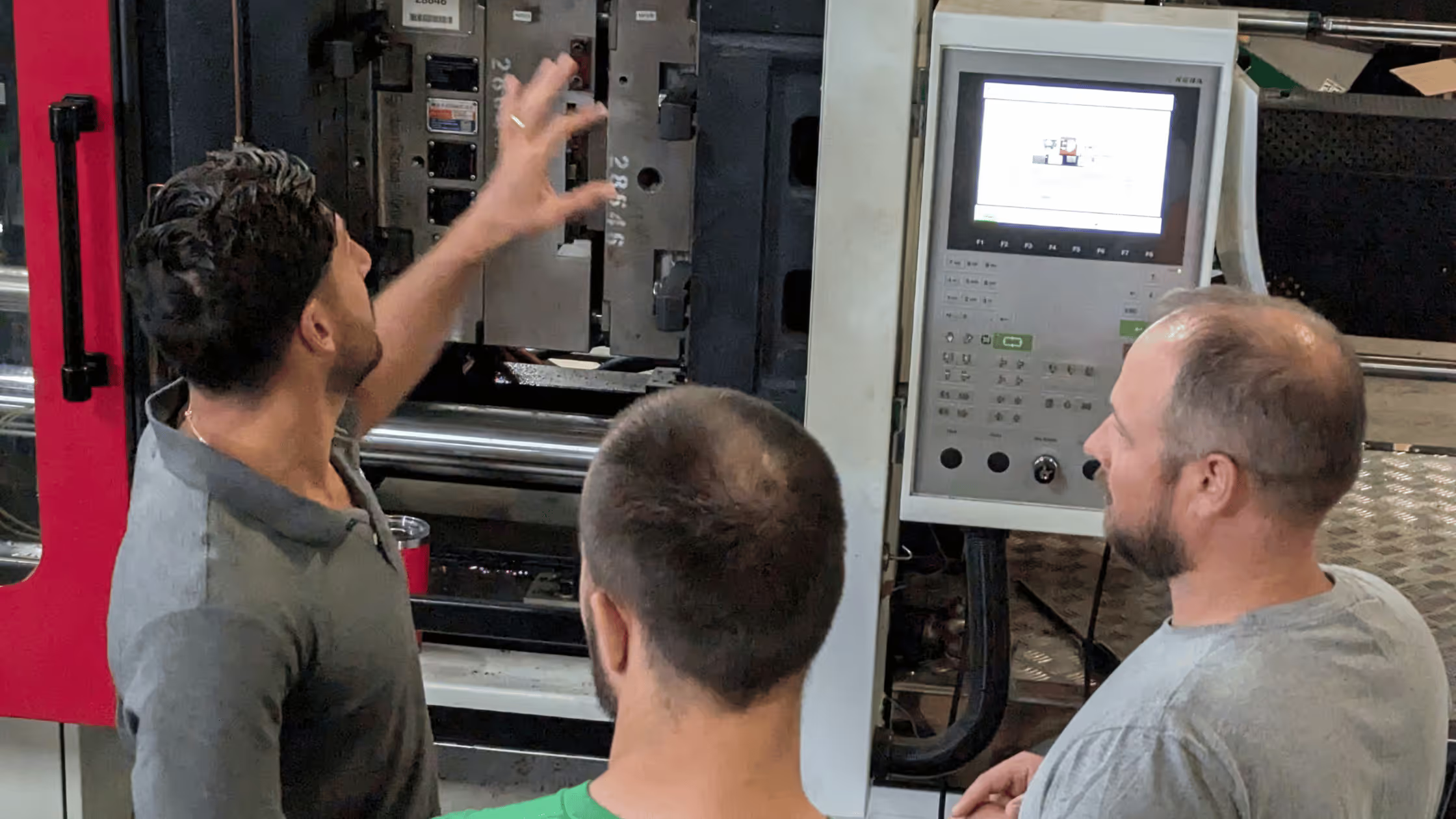
Most production delays start when the schedule assumes machines, labor, materials, and downstream processes will be ready at the right time, but the shop floor is already drifting from plan. A machine stops longer than expected. A setup runs late. A cycle slows down. A downstream process waits for upstream output that never arrived. Lean scheduling methods help control flow, but they depend on accurate machine availability data. Real time machine data gives production teams the live input they need to detect delays earlier, adjust work before disruption compounds, and close the gap between scheduled output and actual production.
Preventing production delays is not only a scheduling problem. It is a visibility problem. A schedule can be well planned and still fail if it is built on stale assumptions about capacity, downtime, setup time, cycle time, and current machine state.
This guide explains how manufacturers can use real time machine data to support lean scheduling, protect delivery commitments, reduce costly firefighting, and keep production moving closer to plan.
Summary
Production delays happen when the shop floor diverges from the schedule faster than the team can see and respond. Lean methods such as takt time, pull production, OEE, and continuous improvement are designed to keep work flowing, but they require current production data to work in daily operations. Real time machine monitoring helps manufacturers detect downtime, verify machine availability, compare planned versus actual output, and feed accurate production data back into future schedules.
What causes production delays in manufacturing?
Production delays usually come from a gap between planned capacity and actual operating conditions. A schedule may assume that a machine will be available for an 8 hour shift, but actual production can be reduced by downtime, setup overruns, material waits, tooling problems, quality holds, operator delays, or slower than expected cycles.
Common delay causes include:
- Machines are scheduled as available when they are actually down, idle, or still in setup.
- Downtime is discovered too late to adjust job sequencing.
- Cycle times drift away from the rates used in scheduling.
- Upstream operations miss output targets and downstream operations wait.
- Maintenance issues interrupt production without early warning.
- Manual reporting delays keep supervisors from seeing the problem during the shift.
- ERP or scheduling systems are updated after the delay has already affected delivery.
The issue is not always poor planning. Many production teams build thoughtful schedules with the information they have. The problem is that the information may be incomplete once the shift begins.
Why lean scheduling needs real time production data
Lean scheduling methods are built around flow, timing, demand signals, and waste reduction. They help manufacturers avoid overproduction, reduce waiting, improve responsiveness, and align output with customer demand. The challenge is that lean scheduling depends on accurate feedback from the production floor.
Takt time, for example, helps match production pace to customer demand. If customer demand requires one part every two minutes, the production system must know whether machines are actually meeting that pace. A schedule based on takt time can still fail if cycle time slows and nobody sees the drift until the end of the shift.
Pull production depends on downstream demand signals. It works best when upstream processes can respond reliably. If an upstream machine is down but the downstream process does not get a timely signal, work can stall, inventory can shift, and supervisors may not know the true constraint until the delay spreads.
OEE helps explain why planned production time does not become good output. It separates losses into Availability, Performance, and Quality. Those losses are useful only when the data behind them is accurate enough to guide action.
Real time machine data gives these lean methods the current operating input they need. It shows what is running, what is stopped, what is producing slowly, and where capacity is being lost.
The delay prevention framework
Production delay prevention should follow a practical sequence:
- Establish a live machine availability baseline.
- Compare schedule assumptions to current machine status.
- Detect downtime and slowdowns before they spread.
- Protect takt time and flow with actual cycle data.
- Use downtime reasons and OEE losses to fix recurring causes.
- Feed actual production performance back into the next schedule.
This sequence keeps the article anchored in methodology rather than software alone. The software matters because it supplies the production data, but the operational value comes from how the team uses that data.
Step 1: Establish a live machine availability baseline
The first step in preventing production delays is knowing which machines are actually available. Schedulers often work from planned capacity, but production teams need live availability to make reliable decisions during the shift.
A live baseline answers simple questions:
- Which machines are running?
- Which machines are idle?
- Which machines are down?
- Which machines are in setup?
- Which machines are producing below expected rate?
Without this baseline, teams may not see a delay until it has already affected downstream work. A job may be assigned to a machine that appears open in the schedule but is still recovering from a prior setup overage or unplanned stoppage.
FloControl converts raw machine signals into organized production data such as utilization, downtime, cycle time, and shift performance. This gives teams current visibility into what is happening across machines and shifts.
Practical action
Start with the machines that most often cause missed delivery dates, schedule changes, or downstream waiting. Monitor machine state by shift and compare actual availability to the schedule assumptions.
Step 2: Compare schedule assumptions to actual machine status
A schedule is only as accurate as the assumptions behind it. If the schedule assumes 480 minutes of available machine time but the machine regularly produces for only 360 minutes, the delay is built into the plan before the shift begins.
This is especially important when schedules rely on historical averages, ERP routings, or standard cycle times that have not been checked against current floor conditions. Actual availability may vary by machine condition, setup complexity, material readiness, operator coverage, maintenance status, and part mix.
Real time machine data lets teams compare the schedule against the floor while the schedule is still active. If the plan says a machine should be running and the machine is idle, stopped, or late in setup, the team can adjust earlier.
For metalworking and precision machining operations, this can include spindle time, cycle performance, unplanned downtime, and verified machine availability. For plastics manufacturers, this can include cycle time, mold changeovers, utilization, downtime reasons, and planned versus actuals.
Practical action
Review planned versus actual machine status at defined points during the shift. Do not wait for the end of shift report to find out whether the schedule was realistic.
Step 3: Detect downtime before it becomes a delivery delay
A single downtime event can disrupt more than one machine. It can delay the current job, shift labor, hold downstream operations, increase work in process, and force customer communication if the delay threatens delivery.
The earlier the team sees downtime, the more options it has. A short stoppage may require a quick maintenance response. A longer stoppage may require job resequencing. A repeat stoppage may require root cause analysis. A bottleneck stoppage may require leadership attention because every minute lost affects the rest of the schedule.
Downtime tracking helps separate downtime by machine, shift, event duration, and cause. That matters because production teams need to know whether the issue is a one time interruption or a repeat pattern that will keep creating delays.
Practical action
Set response thresholds for priority machines. If a constraint machine stops for more than an approved number of minutes, the right person should know immediately and review the schedule impact.
Step 4: Protect takt time with actual cycle data
Takt time connects production pace to customer demand. It helps a team understand how quickly work must move to meet the required output. The challenge is that takt time becomes theoretical if actual cycle times are not visible during production.
If a machine is supposed to produce one part every two minutes but actual production slips to one part every three minutes, the schedule will fall behind even though the machine appears to be running. This kind of delay is harder to spot than a full stoppage because production continues, just at a rate that cannot meet demand.
Real time cycle data helps teams see whether production is staying close to the pace required by the schedule. When cycle times drift, supervisors can investigate tooling, material, operator process, setup, machine condition, or upstream supply before the shortfall reaches the customer.
Practical action
Compare actual cycle time to expected cycle time by job, part, machine, and shift. Flag repeat cycle drift as a schedule risk, not just a performance issue.
Step 5: Use OEE losses to find the reason delays keep repeating
OEE is useful for delay prevention because it separates production losses into three categories:
- Availability losses from downtime, setup delays, and stoppages.
- Performance losses from slow cycles and micro stops.
- Quality losses from scrap and rework.
Each category can create delays in a different way. Availability losses reduce the time available to produce. Performance losses reduce output while the machine is technically running. Quality losses force the team to remake or rework parts that were already scheduled as complete.
A production delay prevention strategy should not treat all delays the same. A recurring setup overage requires a different response than a hydraulic failure, a slow cycle, a material wait, or a quality hold.
The OEE guide is the right supporting resource for teams that need to connect delay prevention to Availability, Performance, and Quality losses.
Practical action
When a delay repeats, classify it as an Availability, Performance, or Quality loss. Then assign the improvement action to the team best positioned to fix that loss.
Step 6: Feed actual performance back into future schedules
Delay prevention does not end when the current shift is fixed. The next schedule should be more accurate because the team learned from what actually happened.
Actual machine availability, downtime, setup duration, cycle time, utilization, and quality performance should feed future planning. If a job repeatedly takes longer than the routing says, the schedule should reflect that. If a machine loses the same type of downtime every week, the plan should address it before the next miss. If a process frequently falls behind after setup, the schedule should account for stabilization time or the team should fix the setup process.
This is how production delay prevention becomes a continuous improvement loop. The schedule sets the plan. Machine data shows the result. The next schedule uses the result to reduce the gap between planned and actual output.
Practical action
Hold a weekly schedule accuracy review. Compare the largest planned versus actual gaps, identify the root cause, and adjust the next schedule or improvement plan accordingly.
Before and after example
Before real time machine data
A scheduler assigns a job to a CNC machine because the ERP schedule shows open capacity.
The machine is still in setup from the previous job.
The setup overage is not visible to the scheduler until a supervisor walks the floor.
The job starts late.
A downstream operation waits for parts.
The team uses overtime to protect the ship date.
The schedule looked accurate at the start of the shift, but it was built on assumed availability.
After real time machine data
The machine reports current status through live monitoring.
The setup overage is visible before the next job is committed.
A smart alert flags the delay risk.
The scheduler reviews alternate machine capacity or adjusts sequencing.
The downstream team receives a clearer expectation.
The next schedule uses actual setup and run time data instead of repeating the same assumption.
The delay may not disappear every time, but the team sees it earlier and has more options before it affects delivery.
Where SensFlo fits
SensFlo fits the production delay prevention workflow where manufacturers need a current source of machine truth. FloControl organizes raw machine signals into production data including utilization, downtime, cycle time, and shift performance. That data helps production, maintenance, and leadership teams see whether the floor is running to plan.
For manufacturers trying to prevent delays, this visibility supports four practical outcomes:
- Earlier downtime detection.
- Better schedule adjustments during the shift.
- More accurate planned versus actual comparisons.
- Stronger future schedules based on actual production behavior.
Published SensFlo results show why this matters. Sharp Plastics increased production hours per machine by 20% and reduced idle time by 88%. Axxis Corporation increased machine utilization by 20% within one month. True Precision Machining achieved a 35% increase in spindle hours with zero staff or machine increase.
Those results are not presented as universal guarantees. They show the practical value of finding lost time, recovering capacity, and acting from current production data.
Implementation checklist
Use this checklist to start preventing production delays with machine data.
- Identify the machines that most often create schedule risk.
- Track live machine status, downtime, idle time, setup time, and cycle time.
- Compare planned production against actual machine availability during the shift.
- Set alerts for downtime or setup overruns on priority machines.
- Compare actual cycle time to expected cycle time.
- Classify recurring delays as Availability, Performance, or Quality losses.
- Assign each repeat delay to an owner and corrective action.
- Review planned versus actual output weekly.
- Update future schedules using actual production behavior.
- Estimate the revenue and savings impact of recovered production time with the ROAI Calculator.
Frequently Asked Questions
What causes production delays in manufacturing?
Production delays are usually caused by a gap between planned capacity and actual shop floor conditions. Machines may be down, idle, late in setup, running slower than expected, waiting on materials, or producing parts that require rework. Real time machine data helps teams see those conditions earlier, before the delay spreads across the schedule.
How can manufacturers prevent production delays?
Manufacturers can prevent production delays by tracking live machine availability, comparing planned output to actual output, detecting downtime early, monitoring cycle time, and using actual production data to improve future schedules. FloControl supports this process by organizing machine signals into utilization, downtime, cycle time, and shift performance data.
How does real time machine data prevent production delays?
Real time machine data prevents delays by showing when production is drifting from plan. It identifies machines that are stopped, idle, late in setup, or running below expected cycle time. This gives schedulers and supervisors time to adjust sequencing, assign support, communicate risk, or address the root cause before the delay becomes a missed delivery.
How does downtime tracking help prevent production delays?
Downtime tracking helps prevent delays by showing which stoppages repeat, which machines lose the most time, and which downtime causes have the largest schedule impact. When teams can rank downtime by lost time and frequency, they can fix the issues most likely to delay production again.
What is the connection between OEE and production delays?
OEE connects production delays to specific losses. Availability losses show when downtime or setup delays reduce planned production time. Performance losses show when slow cycles reduce output while the machine is running. Quality losses show when scrap or rework creates additional production demand. The OEE guide explains how these losses are calculated.
How does takt time help prevent production delays?
Takt time helps prevent production delays by defining the pace required to meet customer demand. If actual cycle time is slower than takt time, the schedule will eventually fall behind. Real time cycle data helps supervisors see when production is missing that required pace and investigate the cause during the shift.
How does pull production relate to delay prevention?
Pull production depends on accurate signals between downstream and upstream operations. If an upstream machine stops or slows down and the downstream process does not receive a timely signal, delays can spread. Real time machine status gives teams a clearer signal when production cannot support the next downstream need.
Can machine monitoring improve schedule accuracy?
Yes. Machine monitoring software improves schedule accuracy by replacing assumptions with actual production data. It shows machine availability, downtime, cycle time, utilization, and shift performance. That helps schedulers compare planned capacity to real conditions and make better decisions before delays compound.
What production delay metrics should manufacturers track?
Manufacturers should track machine availability, downtime hours, setup time, cycle time, idle time, utilization, OEE, planned versus actual output, and repeat delay causes. These metrics show whether delays are coming from downtime, slow cycles, setup issues, material waits, quality problems, or inaccurate schedule assumptions.
How does SensFlo help prevent production delays?
SensFlo helps prevent production delays by giving manufacturers current visibility into machine activity. FloControl converts raw machine signals into production data, including utilization, downtime, cycle time, and shift performance. This helps teams detect delay risks earlier, act during the shift, and improve future schedules with actual machine data.



Talk to us
Let us take your company to the next level. Let’s have a chat and find out how we can help you.

