

Cómo prevenir retrasos en la producción con datos de máquinas en tiempo real
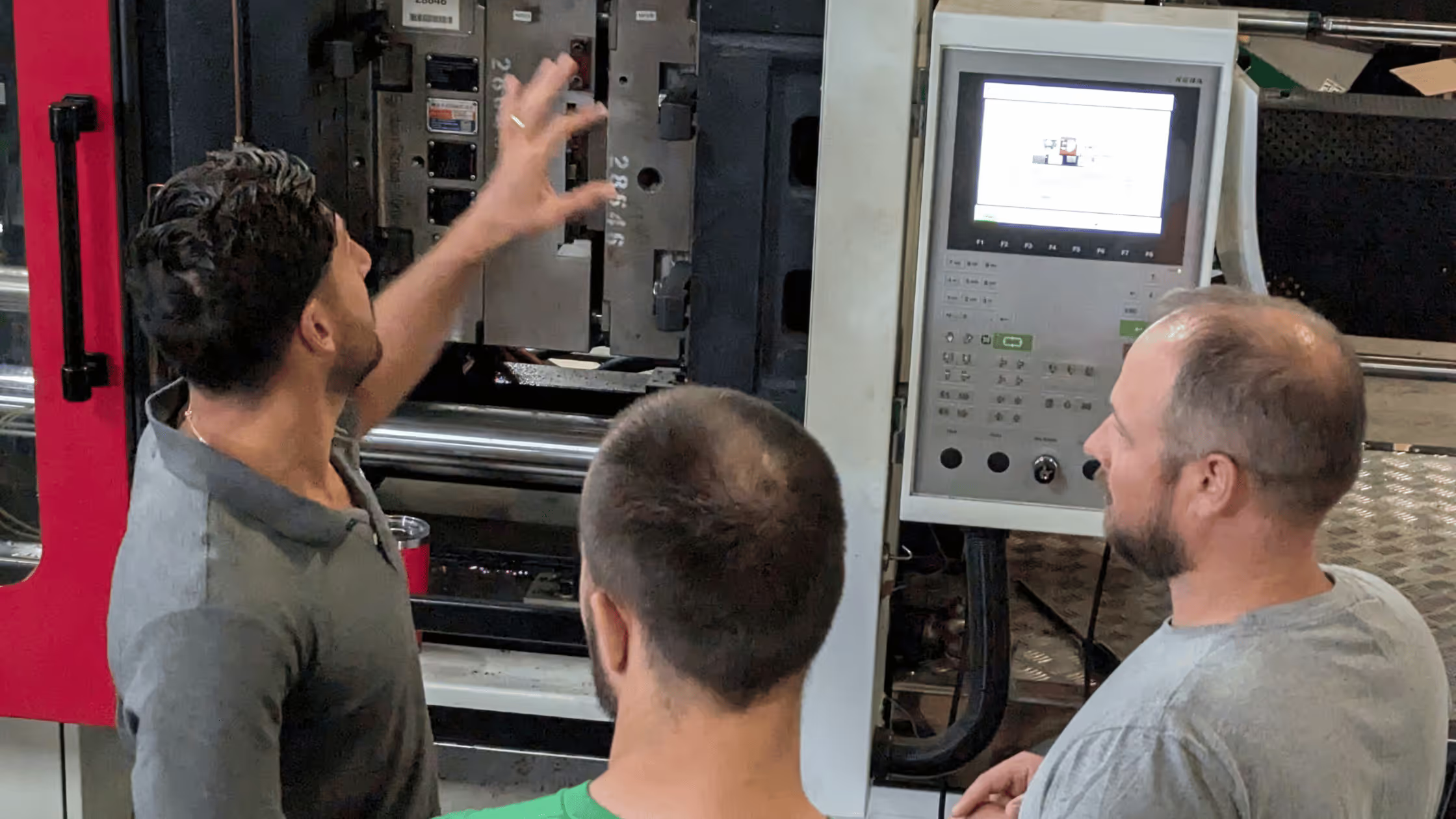
Most production delays start when the schedule assumes machines, labor, materials, and downstream processes will be ready at the right time, but the shop floor is already drifting from plan. A machine stops longer than expected. A setup runs late. A cycle slows down. A downstream process waits for upstream output that never arrived. Lean scheduling methods help control flow, but they depend on accurate machine availability data. Real time machine data gives production teams the live input they need to detect delays earlier, adjust work before disruption compounds, and close the gap between scheduled output and actual production.
Preventing production delays is not only a scheduling problem. It is a visibility problem. A schedule can be well planned and still fail if it is built on stale assumptions about capacity, downtime, setup time, cycle time, and current machine state.
This guide explains how manufacturers can use real time machine data to support lean scheduling, protect delivery commitments, reduce costly firefighting, and keep production moving closer to plan.
Summary
Production delays happen when the shop floor diverges from the schedule faster than the team can see and respond. Lean methods such as takt time, pull production, OEE, and continuous improvement are designed to keep work flowing, but they require current production data to work in daily operations. Real time machine monitoring helps manufacturers detect downtime, verify machine availability, compare planned versus actual output, and feed accurate production data back into future schedules.
What causes production delays in manufacturing?
Production delays usually come from a gap between planned capacity and actual operating conditions. A schedule may assume that a machine will be available for an 8 hour shift, but actual production can be reduced by downtime, setup overruns, material waits, tooling problems, quality holds, operator delays, or slower than expected cycles.
Common delay causes include:
- Machines are scheduled as available when they are actually down, idle, or still in setup.
- Downtime is discovered too late to adjust job sequencing.
- Cycle times drift away from the rates used in scheduling.
- Upstream operations miss output targets and downstream operations wait.
- Maintenance issues interrupt production without early warning.
- Manual reporting delays keep supervisors from seeing the problem during the shift.
- ERP or scheduling systems are updated after the delay has already affected delivery.
The issue is not always poor planning. Many production teams build thoughtful schedules with the information they have. The problem is that the information may be incomplete once the shift begins.
Why lean scheduling needs real time production data
Lean scheduling methods are built around flow, timing, demand signals, and waste reduction. They help manufacturers avoid overproduction, reduce waiting, improve responsiveness, and align output with customer demand. The challenge is that lean scheduling depends on accurate feedback from the production floor.
Takt time, for example, helps match production pace to customer demand. If customer demand requires one part every two minutes, the production system must know whether machines are actually meeting that pace. A schedule based on takt time can still fail if cycle time slows and nobody sees the drift until the end of the shift.
Pull production depends on downstream demand signals. It works best when upstream processes can respond reliably. If an upstream machine is down but the downstream process does not get a timely signal, work can stall, inventory can shift, and supervisors may not know the true constraint until the delay spreads.
OEE helps explain why planned production time does not become good output. It separates losses into Availability, Performance, and Quality. Those losses are useful only when the data behind them is accurate enough to guide action.
Real time machine data gives these lean methods the current operating input they need. It shows what is running, what is stopped, what is producing slowly, and where capacity is being lost.
The delay prevention framework
Production delay prevention should follow a practical sequence:
- Establish a live machine availability baseline.
- Compare schedule assumptions to current machine status.
- Detect downtime and slowdowns before they spread.
- Protect takt time and flow with actual cycle data.
- Use downtime reasons and OEE losses to fix recurring causes.
- Feed actual production performance back into the next schedule.
This sequence keeps the article anchored in methodology rather than software alone. The software matters because it supplies the production data, but the operational value comes from how the team uses that data.
Step 1: Establish a live machine availability baseline
The first step in preventing production delays is knowing which machines are actually available. Schedulers often work from planned capacity, but production teams need live availability to make reliable decisions during the shift.
A live baseline answers simple questions:
- Which machines are running?
- Which machines are idle?
- Which machines are down?
- Which machines are in setup?
- Which machines are producing below expected rate?
Without this baseline, teams may not see a delay until it has already affected downstream work. A job may be assigned to a machine that appears open in the schedule but is still recovering from a prior setup overage or unplanned stoppage.
FloControl converts raw machine signals into organized production data such as utilization, downtime, cycle time, and shift performance. This gives teams current visibility into what is happening across machines and shifts.
Practical action
Start with the machines that most often cause missed delivery dates, schedule changes, or downstream waiting. Monitor machine state by shift and compare actual availability to the schedule assumptions.
Step 2: Compare schedule assumptions to actual machine status
A schedule is only as accurate as the assumptions behind it. If the schedule assumes 480 minutes of available machine time but the machine regularly produces for only 360 minutes, the delay is built into the plan before the shift begins.
This is especially important when schedules rely on historical averages, ERP routings, or standard cycle times that have not been checked against current floor conditions. Actual availability may vary by machine condition, setup complexity, material readiness, operator coverage, maintenance status, and part mix.
Real time machine data lets teams compare the schedule against the floor while the schedule is still active. If the plan says a machine should be running and the machine is idle, stopped, or late in setup, the team can adjust earlier.
For metalworking and precision machining operations, this can include spindle time, cycle performance, unplanned downtime, and verified machine availability. For plastics manufacturers, this can include cycle time, mold changeovers, utilization, downtime reasons, and planned versus actuals.
Practical action
Review planned versus actual machine status at defined points during the shift. Do not wait for the end of shift report to find out whether the schedule was realistic.
Step 3: Detect downtime before it becomes a delivery delay
A single downtime event can disrupt more than one machine. It can delay the current job, shift labor, hold downstream operations, increase work in process, and force customer communication if the delay threatens delivery.
The earlier the team sees downtime, the more options it has. A short stoppage may require a quick maintenance response. A longer stoppage may require job resequencing. A repeat stoppage may require root cause analysis. A bottleneck stoppage may require leadership attention because every minute lost affects the rest of the schedule.
Downtime tracking helps separate downtime by machine, shift, event duration, and cause. That matters because production teams need to know whether the issue is a one time interruption or a repeat pattern that will keep creating delays.
Practical action
Set response thresholds for priority machines. If a constraint machine stops for more than an approved number of minutes, the right person should know immediately and review the schedule impact.
Step 4: Protect takt time with actual cycle data
Takt time connects production pace to customer demand. It helps a team understand how quickly work must move to meet the required output. The challenge is that takt time becomes theoretical if actual cycle times are not visible during production.
If a machine is supposed to produce one part every two minutes but actual production slips to one part every three minutes, the schedule will fall behind even though the machine appears to be running. This kind of delay is harder to spot than a full stoppage because production continues, just at a rate that cannot meet demand.
Real time cycle data helps teams see whether production is staying close to the pace required by the schedule. When cycle times drift, supervisors can investigate tooling, material, operator process, setup, machine condition, or upstream supply before the shortfall reaches the customer.
Practical action
Compare actual cycle time to expected cycle time by job, part, machine, and shift. Flag repeat cycle drift as a schedule risk, not just a performance issue.
Step 5: Use OEE losses to find the reason delays keep repeating
OEE is useful for delay prevention because it separates production losses into three categories:
- Availability losses from downtime, setup delays, and stoppages.
- Performance losses from slow cycles and micro stops.
- Quality losses from scrap and rework.
Each category can create delays in a different way. Availability losses reduce the time available to produce. Performance losses reduce output while the machine is technically running. Quality losses force the team to remake or rework parts that were already scheduled as complete.
A production delay prevention strategy should not treat all delays the same. A recurring setup overage requires a different response than a hydraulic failure, a slow cycle, a material wait, or a quality hold.
The OEE guide is the right supporting resource for teams that need to connect delay prevention to Availability, Performance, and Quality losses.
Practical action
When a delay repeats, classify it as an Availability, Performance, or Quality loss. Then assign the improvement action to the team best positioned to fix that loss.
Step 6: Feed actual performance back into future schedules
Delay prevention does not end when the current shift is fixed. The next schedule should be more accurate because the team learned from what actually happened.
Actual machine availability, downtime, setup duration, cycle time, utilization, and quality performance should feed future planning. If a job repeatedly takes longer than the routing says, the schedule should reflect that. If a machine loses the same type of downtime every week, the plan should address it before the next miss. If a process frequently falls behind after setup, the schedule should account for stabilization time or the team should fix the setup process.
This is how production delay prevention becomes a continuous improvement loop. The schedule sets the plan. Machine data shows the result. The next schedule uses the result to reduce the gap between planned and actual output.
Practical action
Hold a weekly schedule accuracy review. Compare the largest planned versus actual gaps, identify the root cause, and adjust the next schedule or improvement plan accordingly.
Before and after example
Before real time machine data
A scheduler assigns a job to a CNC machine because the ERP schedule shows open capacity.
The machine is still in setup from the previous job.
The setup overage is not visible to the scheduler until a supervisor walks the floor.
The job starts late.
A downstream operation waits for parts.
The team uses overtime to protect the ship date.
The schedule looked accurate at the start of the shift, but it was built on assumed availability.
After real time machine data
The machine reports current status through live monitoring.
The setup overage is visible before the next job is committed.
A smart alert flags the delay risk.
The scheduler reviews alternate machine capacity or adjusts sequencing.
El equipo siguiente tiene una expectativa más clara.
La próxima programación utiliza datos reales de configuración y tiempo de ejecución en lugar de repetir la misma suposición.
El retraso quizás no desaparezca siempre, pero el equipo lo detecta antes y tiene más opciones antes de que afecte la entrega.
Dónde encaja SensFlo
SensFlo se ajusta al flujo de trabajo de prevención de retrasos en la producción, donde los fabricantes necesitan una fuente actual de información fidedigna de las máquinas. FloControl organiza las señales brutas de las máquinas en datos de producción, incluyendo la utilización, el tiempo de inactividad, el tiempo de ciclo y el rendimiento por turno. Esos datos ayudan a los equipos de producción, mantenimiento y liderazgo a ver si la planta está funcionando según lo previsto.
Para los fabricantes que intentan evitar retrasos, esta visibilidad permite cuatro resultados prácticos:
- Detección anticipada de inactividad.
- Ajustes de programación más efectivos durante el turno.
- Comparaciones más precisas entre lo planificado y lo real.
- Programaciones futuras más sólidas basadas en el comportamiento real de la producción.
Los resultados publicados de SensFlo muestran por qué esto es importante. Sharp Plastics aumentó las horas de producción por máquina en un 20% y redujo el tiempo de inactividad en un 88%. Axxis Corporation aumentó la utilización de la máquina en un 20% en un mes. True Precision Machining logró un aumento del 35% en las horas de husillo sin aumentar el personal ni las máquinas.
Esos resultados no se presentan como garantías universales. Muestran el valor práctico de encontrar el tiempo perdido, recuperar capacidad y actuar a partir de los datos de producción actuales.
Lista de verificación para la implementación
Utilice esta lista de verificación para empezar a evitar retrasos en la producción con datos de máquinas.
- Identifique las máquinas que con mayor frecuencia generan riesgo en la programación.
- Monitoree el estado de las máquinas en tiempo real, el tiempo de inactividad, el tiempo ocioso, el tiempo de configuración y el tiempo de ciclo.
- Compare la producción planificada frente a la disponibilidad real de las máquinas durante el turno.
- Configure alertas por tiempo de inactividad o excesos en el tiempo de configuración en máquinas prioritarias.
- Compare el tiempo de ciclo real con el tiempo de ciclo esperado.
- Clasifique los retrasos recurrentes como pérdidas de Disponibilidad, Rendimiento o Calidad.
- Asigne cada retraso recurrente a un responsable y una acción correctiva.
- Revise semanalmente la producción planificada frente a la real.
- Actualice las programaciones futuras utilizando el comportamiento real de la producción.
- Estime el impacto en los ingresos y ahorros del tiempo de producción recuperado con la ROAI Calculator.
Preguntas Frecuentes
¿Qué causa los retrasos en la producción manufacturera?
Los retrasos en la producción suelen ser causados por una brecha entre la capacidad planificada y las condiciones reales en el taller. Las máquinas pueden estar paradas, inactivas, con retraso en la configuración, funcionando más lento de lo esperado, esperando materiales o produciendo piezas que requieren retrabajo. Los datos de máquinas en tiempo real ayudan a los equipos a detectar esas condiciones antes, antes de que el retraso se extienda por todo el programa.
¿Cómo pueden los fabricantes prevenir los retrasos en la producción?
Los fabricantes pueden prevenir los retrasos en la producción al rastrear la disponibilidad de las máquinas en vivo, comparar la producción planificada con la producción real, detectar el tiempo de inactividad temprano, monitorear el tiempo de ciclo y usar datos de producción reales para mejorar los programas futuros. FloControl apoya este proceso organizando las señales de la máquina en datos de utilización, tiempo de inactividad, tiempo de ciclo y rendimiento por turno.
¿Cómo previenen los datos de máquinas en tiempo real los retrasos en la producción?
Los datos de máquinas en tiempo real previenen los retrasos al mostrar cuándo la producción se desvía del plan. Identifica las máquinas que están paradas, inactivas, con retraso en la configuración o funcionando por debajo del tiempo de ciclo esperado. Esto da tiempo a los programadores y supervisores para ajustar la secuencia, asignar apoyo, comunicar riesgos o abordar la causa raíz antes de que el retraso se convierta en una entrega incumplida.
¿Cómo ayuda el seguimiento del tiempo de inactividad a prevenir los retrasos en la producción?
El seguimiento del tiempo de inactividad ayuda a prevenir retrasos al mostrar qué paradas se repiten, qué máquinas pierden más tiempo y qué causas de tiempo de inactividad tienen el mayor impacto en el programa. Cuando los equipos pueden clasificar el tiempo de inactividad por tiempo perdido y frecuencia, pueden solucionar los problemas con mayor probabilidad de retrasar la producción nuevamente.
¿Cuál es la conexión entre el OEE y los retrasos en la producción?
El OEE conecta los retrasos en la producción con pérdidas específicas. Las pérdidas por disponibilidad muestran cuándo el tiempo de inactividad o los retrasos en la configuración reducen el tiempo de producción planificado. Las pérdidas por rendimiento muestran cuándo los ciclos lentos reducen la producción mientras la máquina está funcionando. Las pérdidas por calidad muestran cuándo el desecho o el retrabajo crean una demanda de producción adicional. La guía de OEE explica cómo se calculan estas pérdidas.
¿Cómo ayuda el tiempo takt a prevenir los retrasos en la producción?
El tiempo takt ayuda a prevenir los retrasos en la producción al definir el ritmo necesario para satisfacer la demanda del cliente. Si el tiempo de ciclo real es más lento que el tiempo takt, el programa eventualmente se retrasará. Los datos de ciclo en tiempo real ayudan a los supervisores a ver cuándo la producción no está cumpliendo con el ritmo requerido e investigar la causa durante el turno.
¿Cómo se relaciona la producción pull con la prevención de retrasos?
La producción pull depende de señales precisas entre las operaciones posteriores y anteriores. Si una máquina anterior se detiene o ralentiza y el proceso posterior no recibe una señal oportuna, los retrasos pueden extenderse. El estado de la máquina en tiempo real proporciona a los equipos una señal más clara cuando la producción no puede satisfacer la siguiente necesidad posterior.
¿Puede el monitoreo de máquinas mejorar la precisión de la programación?
Sí. Software de monitoreo de máquinas mejora la precisión de la programación al reemplazar las suposiciones con datos de producción reales. Muestra la disponibilidad de la máquina, el tiempo de inactividad, el tiempo de ciclo, la utilización y el rendimiento del turno. Esto ayuda a los programadores a comparar la capacidad planificada con las condiciones reales y a tomar mejores decisiones antes de que los retrasos se acumulen.
¿Qué métricas de retraso de producción deben seguir los fabricantes?
Los fabricantes deben seguir la disponibilidad de la máquina, las horas de inactividad, el tiempo de preparación, el tiempo de ciclo, el tiempo de inactividad, la utilización, el OEE, la producción planificada versus la real y las causas de retrasos recurrentes. Estas métricas muestran si los retrasos provienen del tiempo de inactividad, ciclos lentos, problemas de preparación, esperas de material, problemas de calidad o suposiciones de programación inexactas.
¿Cómo ayuda SensFlo a prevenir los retrasos en la producción?
SensFlo ayuda a prevenir los retrasos en la producción al proporcionar a los fabricantes visibilidad en tiempo real de la actividad de la máquina. FloControl convierte las señales brutas de la máquina en datos de producción, incluyendo la utilización, el tiempo de inactividad, el tiempo de ciclo y el rendimiento del turno. Esto ayuda a los equipos a detectar riesgos de retraso con antelación, actuar durante el turno y mejorar los programas futuros con datos reales de la máquina.
Tal vez te interese...


Hablemos
Queremos llevar tu empresa al siguiente nivel. Conversemos para ver cómo podemos ayudarte.
Correo electrónico
info@sensflo.aiTeléfono:
+1 (415) 622-5692Dirección:
21300 Victory Blvd #300, Woodland Hills, CA 91367, Estados Unidos

