

Real Time OEE Monitoring for Injection Molding: A Plastics Manufacturer’s Guide to Downtime, Cycle Time, and Press Utilization
Key Takeaway
Real time OEE monitoring helps plastics manufacturers see where scheduled production time is being lost across press availability, cycle time performance, and good part output.
OEE.com defines OEE as Availability × Performance × Quality. For injection molding, that means press uptime, actual cycle performance, and the percentage of parts that meet quality requirements.
McKinsey reports that predictive maintenance typically reduces machine downtime by 30 to 50 percent and increases machine life by 20 to 40 percent. For plastics plants, that visibility matters across presses, molds, chillers, dryers, pumps, and auxiliary equipment.
SensFlo’s Sharp Plastics success story showed a 20 percent increase in production hours per machine, an 88 percent reduction in idle time, and a 62 percent average work time increase.
FloControl gives plastics teams live visibility into utilization, downtime, cycle time, and shift performance, helping teams recover more sellable production hours from the equipment they already own.
Real time OEE monitoring software for plastics manufacturers tracks press availability, cycle time, downtime, idle time, and quality losses as production happens. SensFlo’s FloControl platform gives injection molders live visibility into where capacity is being lost by machine, mold, shift, and job, so teams can increase output, reduce avoidable waste, and improve margins without adding new presses.
Injection molding is a capacity business. Every press has a scheduled number of hours. Every mold has an expected cycle. Every job carries a margin that depends on staying close to plan. When production data is delayed, incomplete, or manually entered after the fact, the plant loses its ability to react while the loss is still recoverable.
That is why OEE monitoring matters. It connects the daily reality of plastics manufacturing to a clear operating question:
How much scheduled press time is becoming good parts at the expected cycle rate?
For many injection molders, the answer is lower than expected. Some losses are easy to see, including press downtime, mold changes, and maintenance events. Other losses hide inside normal production, including short stops, slower cycles, extended cooling time, idle time between jobs, startup scrap, and recurring quality issues.
Real time monitoring makes those losses measurable while the shift is still active.
What is real time OEE monitoring for plastics manufacturers?
Real time OEE monitoring is the continuous measurement of equipment effectiveness across Availability, Performance, and Quality. For plastics manufacturers, these three factors connect directly to press utilization, cycle time, and good part output.
Availability measures whether a press is running when it is scheduled to run. Availability loss includes unplanned downtime, mold change delays, material shortages, maintenance events, operator delays, blocked auxiliary equipment, and idle time between jobs.
Performance measures whether the press is running at the expected speed. In injection molding, performance loss often appears as cycle time drift, longer cooling time, slower screw recovery, process instability, micro stops, or a job running below its quoted rate.
Quality measures whether the output is good. Quality loss includes scrap, rejected parts, startup waste, rework, dimensional issues, cosmetic defects, and material related failures.
The standard formula is:
OEE = Availability × Performance × Quality
A press can look busy and still have weak OEE. A machine may be running most of the day, but if it is cycling slower than expected or producing excess scrap, the plant is still losing capacity and margin.
Real time OEE monitoring helps teams separate those losses. Instead of treating every production miss as a general downtime issue, the plant can see whether the real problem is availability loss, cycle performance, or quality.
Why OEE is difficult to measure manually in injection molding
Injection molding moves fast. Depending on the part, a single press may cycle every few seconds. Across a full facility, thousands of cycles can happen before a supervisor sees the next report. Manual tracking usually cannot capture that level of detail.
The biggest issue is timing. A handwritten log, shift report, or end of day spreadsheet may show that a job missed target, but it rarely shows when the loss started, how long it lasted, or whether the root cause was downtime, slower cycles, or scrap.
Manual OEE tracking also depends on consistent operator input. When the floor is busy, small stops are easy to miss. A five minute delay may not feel worth logging, but enough short stops across a shift can erase meaningful production capacity. The plant may lose hours each week without a clear record of where they went.
Injection molding also has process variables that change quickly. Cooling issues, pressure variation, temperature drift, material feed problems, and mold related events can affect cycle time and quality before anyone sees the full effect in finished parts.
Real time OEE monitoring closes that gap. It gives production, maintenance, and leadership a shared view of what happened, when it happened, and which loss category deserves attention first.
How FloControl tracks OEE in injection molding operations
FloControl converts machine signals into live production data, including utilization, downtime, cycle time, idle time, and shift performance. For plastics manufacturers, that creates a practical OEE layer over the press floor.
Instead of depending only on manual reporting, FloControl helps teams see whether each press is running, idle, stopped, or drifting from expected performance. The platform supports visibility into machine status, production behavior, downtime events, and shift level output, giving operators and managers a clearer picture of how each cell is performing.
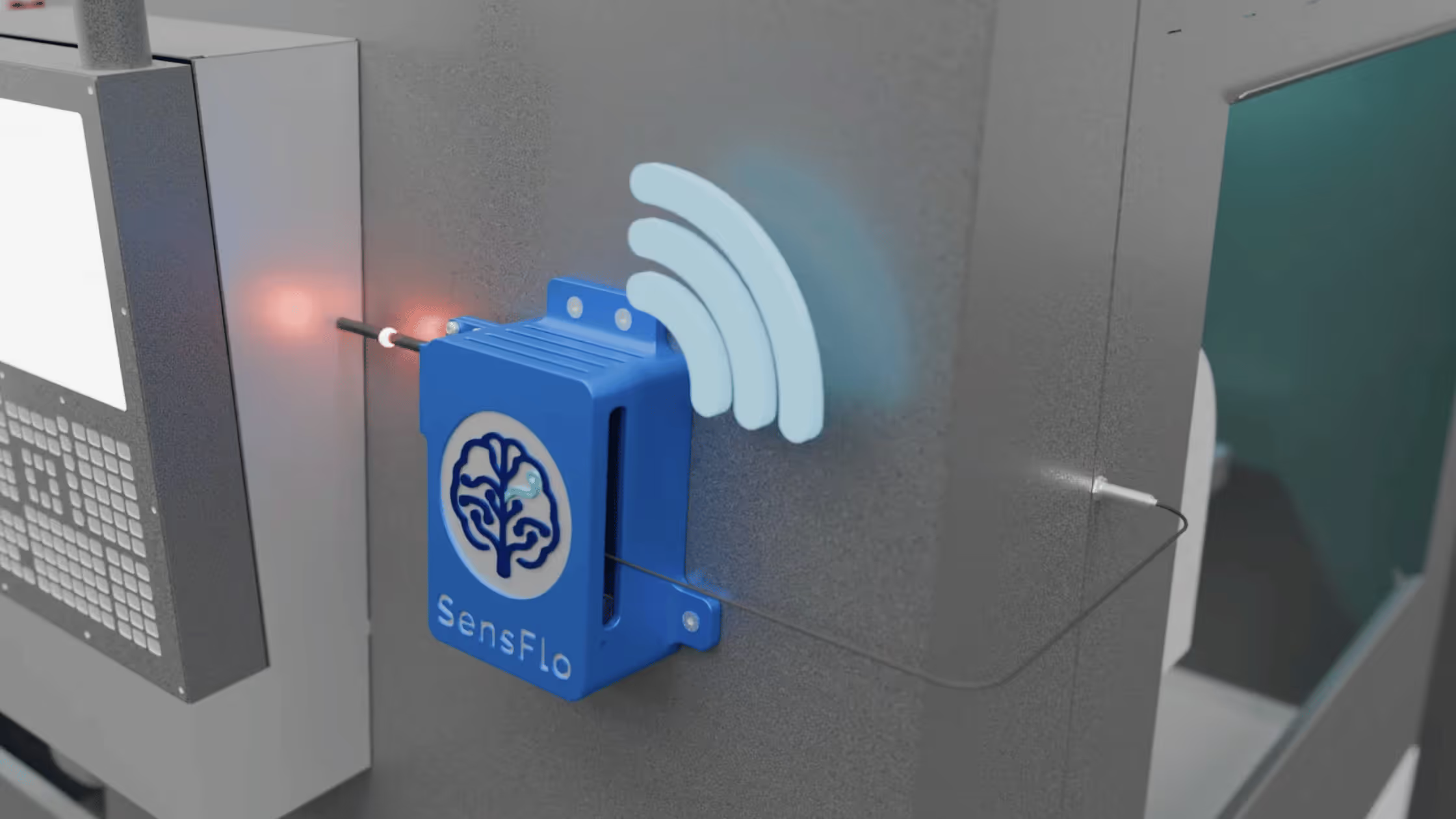
For plants that want a fast starting point, SensFlo sensors can attach to equipment without wiring into the control system. This makes monitoring practical for facilities with mixed press ages, limited engineering bandwidth, or machines where PLC access is difficult.
For operations with deeper data needs, SensFlo can support more advanced data paths as the monitoring program matures. This may include ERP, MES, PLC, SCADA, or job data depending on what the facility already has available and what the team needs to measure.
The practical value is the speed of insight. Teams can answer production questions while the shift is still running.
Which presses are running right now?
Which machines are idle?
Which jobs are falling behind plan?
Where is cycle time drifting?
Which downtime reasons repeat?
Which shifts are losing the most available time?
Which machines are creating the biggest margin leakage?
When OEE is visible in real time, improvement becomes more direct. Teams can address the loss category that is hurting production today instead of waiting for a monthly report.
The three OEE losses plastics manufacturers need to see first
OEE is useful because it separates lost production into categories. For injection molders, the first improvement opportunity is usually finding which type of loss is causing the biggest financial effect.
Availability loss: when presses are scheduled but not producing
Availability loss is the easiest OEE problem to understand because it shows up as stop time. In injection molding, this can include press failures, mold change delays, missing material, blocked cooling circuits, hot runner issues, maintenance delays, operator coverage gaps, and time between jobs.
Availability loss directly affects top line revenue because the press is not producing parts that can be shipped and sold. It also affects bottom line savings because downtime often triggers overtime, expediting, missed delivery penalties, maintenance costs, and underused labor.
FloControl helps expose availability loss by showing when a machine was running, idle, or stopped. Once the loss is visible, teams can connect downtime to the press, mold, job, shift, or operating condition that caused it.
Performance loss: when presses run slower than expected
Performance loss is harder to catch because the machine is still running. The press may appear productive, but cycle time has drifted from the standard. A job quoted at a certain cycle rate may slowly lose output because cooling time increased, material behavior changed, screw recovery slowed, or the process was adjusted to prevent defects.
Small cycle changes compound quickly. A few extra seconds per cycle can become hundreds or thousands of lost parts across a week, especially in high volume plastics production.
FloControl helps teams compare actual production behavior against expected performance. This makes it easier to see when a job is producing below plan before the schedule miss becomes a customer issue.
Quality loss: when production runs but parts do not pass
Quality loss is the most deceptive OEE category because the press may be running and cycle time may look acceptable, but the plant is still losing usable output. Scrap, rework, startup waste, short shots, flash, warpage, sink marks, dimensional variation, and cosmetic issues all reduce the amount of good product coming off the machine.
For plastics manufacturers, quality loss affects revenue and cost at the same time. The plant spends labor, material, machine time, and energy producing parts that cannot be sold at full value. In resin intensive operations, scrap also has a direct material cost that can move margin quickly.
OEE monitoring does not replace quality inspection. It gives teams the production context around quality loss, including which machine, mold, shift, and job conditions were present when the loss occurred.
How real time OEE monitoring improves top line revenue and bottom line savings
The financial case for OEE monitoring is straightforward: every manufacturer already owns a fixed amount of press capacity. The question is how much of that capacity becomes saleable product.
Real time OEE monitoring supports top line revenue by helping plants recover production hours that were already scheduled but were not producing. More available press time means more completed jobs, better delivery performance, and more room to accept additional work without immediately adding equipment.
It supports bottom line savings by reducing the waste attached to poor visibility. Less unplanned downtime can mean fewer emergency repairs. Better cycle time control can reduce overtime and rescheduling. Better quality visibility can reduce scrap, rework, and wasted resin.
Better machine level data can also help leadership make smarter capital decisions. Before buying another press, the team can see whether the current floor still has hidden capacity available.
For plastics manufacturers, the value is highest when OEE data becomes part of daily management. A weekly report may explain what went wrong. A live view helps the team act while there is still time to save the shift.
What a realistic OEE baseline looks like for injection molders
There is no single OEE number that applies to every plastics plant. A high volume molder running stable parts may have a very different target than a mid size operation with frequent changeovers, multiple materials, short runs, and complex quality requirements.
Many injection molders discover that their true OEE is lower than expected once short stops, idle time, startup scrap, and cycle time drift are measured automatically. That is useful information. It means the plant finally has a reliable baseline.
The first goal should be accuracy. Before setting an aggressive target, the team needs a clean view of actual run time, planned stop time, unplanned downtime, actual cycle performance, and good part output.
From there, improvement can be tied to the losses with the strongest financial effect.
For one facility, the best opportunity may be reducing mold change delays. For another, it may be controlling cycle drift on repeat jobs. For another, it may be finding idle time between jobs that never appeared in manual reporting.
OEE becomes useful when it points to a specific action.
OEE monitoring software comparison for plastics manufacturers
The best OEE monitoring option depends on how the plant runs today, how quickly the team needs visibility, and how much integration work the operation is ready to support.
For SensFlo, the strongest fit is a plastics manufacturer that wants to move quickly from limited visibility to live production intelligence. FloControl gives the team a practical starting layer for machine utilization, downtime, cycle time, and shift performance, then supports deeper data paths as the plant becomes more mature.
For buyers still learning the OEE category, the important question is simple:
Can the platform show where production time is being lost in a way operators, supervisors, maintenance, and leadership can all act on?
If the answer is yes, OEE can become a daily production tool rather than a monthly reporting metric.
How FloControl compares to manual OEE tracking
Manual OEE tracking can work as a starting point, but it usually misses the losses that happen between check ins. In injection molding, short stops, cycle drift, idle time, and startup scrap can add up quickly. A spreadsheet may capture the final miss, but it rarely captures the live pattern that caused it.
FloControl gives teams machine level visibility without waiting for a manual report. That matters because production losses are more valuable when they are still active. A supervisor can respond to idle time, a maintenance lead can see repeated stops, and leadership can understand whether lost capacity is coming from availability, performance, or quality.
Manual tracking also creates alignment issues. Operators, supervisors, schedulers, and managers may all use different definitions for downtime or utilization. FloControl gives the team a shared view, which helps daily production meetings focus on the highest value losses.
Where FloControl fits for plastics manufacturers
FloControl is built for manufacturers that need useful production visibility without turning machine monitoring into a long implementation project. For injection molders, it gives teams a way to track utilization, downtime, cycle time, and shift performance across machines that may vary by age, brand, controller access, and production role.
That matters in real plastics plants. Many facilities run a mix of older presses, newer machines, auxiliary systems, and supporting equipment. Some machines may expose rich controller data. Others may not. A monitoring strategy that depends on perfect integration before producing value can delay the visibility the plant needs.
SensFlo’s approach lets plastics manufacturers start with real time machine signals and build from there. Teams can identify idle time, monitor utilization, track downtime, compare production behavior across shifts, and move toward deeper job level intelligence as the data foundation matures.
Sharp Plastics is one example of the business case. After deploying SensFlo, the company increased production hours per machine by 20 percent, reduced idle time by 88 percent, and improved average work time by 62 percent. Those results matter because they connect operational visibility to financial performance.
More productive machine hours create more output from the same equipment. Less idle time reduces hidden capacity loss. Better work time gives the team a stronger foundation for planning, scheduling, and customer delivery.
How OEE monitoring supports TPM and predictive maintenance
OEE monitoring also supports Total Productive Maintenance, often called TPM, by giving maintenance and production teams a shared view of equipment behavior.
In plastics manufacturing, TPM depends on early visibility. The plant needs to know which assets are losing availability, which recurring stops are affecting production, and which machines are showing patterns that may lead to downtime.
Real time monitoring helps teams move from calendar based maintenance alone to condition aware decisions. If a press, dryer, chiller, pump, or auxiliary system is showing abnormal run behavior, the team can investigate before the issue becomes a larger production loss.
This is where McKinsey’s predictive maintenance benchmark becomes relevant. Predictive maintenance programs can reduce machine downtime by 30 to 50 percent and increase machine life by 20 to 40 percent. For injection molders, better data can support the maintenance decisions that protect availability, schedule reliability, and part output.
How to start improving injection molding OEE
Improving OEE begins with a clear baseline and a small set of decisions the team can act on.
Start with the machines that matter most. This may be the highest revenue presses, the most constrained work centers, the machines with the most downtime, or the jobs with the greatest margin pressure.
Then define the first measurement layer.
What time was scheduled for production?
When did each press actually run?
When was it idle?
When did it stop?
How long did each stop last?
How did actual cycle time compare with the expected cycle?
How much good output was produced?
From there, separate the losses into Availability, Performance, and Quality. That single step changes the conversation. Instead of saying a job missed target, the team can identify whether the issue was lost time, slower cycles, or rejected output.
The next step is routine. Review the data by shift, machine, mold, and job. Look for recurring losses. Pick the highest value issue. Assign ownership. Track whether the change improves the next run.
This is where real time monitoring creates value. It gives the plant a repeatable operating rhythm: see the loss, act on the loss, measure the effect, and keep improving.
Continue learning
If you are still defining the business case, start with SensFlo’s ROAI Calculator to estimate how recovered machine time can affect revenue and savings.
If your team is focused on the platform itself, visit FloControl to see how SensFlo monitors live machine behavior.
If you are evaluating the plastics use case, review the SensFlo plastics manufacturing page for industry specific applications.
If you want a customer example, read the Sharp Plastics success story.
If you need the OEE formula, review the OEE.com calculation guide.
If you are building the maintenance case, review McKinsey’s article on manufacturing analytics, productivity, and predictive maintenance.
Frequently Asked Questions
What is real time OEE monitoring for plastics manufacturers?
Real time OEE monitoring tracks how much scheduled press time becomes good production at the expected cycle rate. For plastics manufacturers, it measures Availability, Performance, and Quality using live machine data such as run time, downtime, cycle behavior, idle time, and quality loss. The goal is to show where capacity is being lost while the shift is still active.
How is OEE calculated for injection molding?
OEE for injection molding is calculated as Availability × Performance × Quality. Availability measures whether the press ran during planned production time. Performance measures whether the press held the expected cycle rate. Quality measures the percentage of good parts produced. A press can have strong uptime but weak OEE if cycles slow down or scrap increases.
How does OEE monitoring reduce downtime in plastics production?
OEE monitoring reduces downtime by showing when a press stops, how long the stop lasts, and whether the same issue repeats by machine, mold, job, or shift. This helps teams prioritize the downtime causes with the largest production effect, such as mold change delays, cooling issues, material shortages, maintenance events, or recurring machine faults.
What causes the biggest OEE losses in injection molding?
The biggest OEE losses in injection molding usually come from unplanned downtime, cycle time drift, mold change delays, startup scrap, material issues, and quality defects. Availability loss stops the press. Performance loss slows output while the press is running. Quality loss reduces saleable parts. Real time monitoring separates these losses so teams can act on the right problem.
Can SensFlo track OEE without connecting to a PLC or SCADA system?
Yes. SensFlo can begin tracking machine behavior without requiring direct PLC or SCADA access by using machine signals to monitor run time, idle time, stops, cycle behavior, and utilization. This helps plastics manufacturers start monitoring faster, especially when presses vary by age, brand, or controller access. Deeper integrations can be added when richer job or system data is needed.
What is a realistic OEE baseline for a mid size injection molder?
A realistic OEE baseline depends on product mix, cycle complexity, changeover frequency, staffing, material variation, and quality requirements. Many mid size injection molders find their measured OEE is lower than expected once short stops, idle time, cycle drift, and startup scrap are captured automatically. The best starting point is an accurate baseline by press, mold, job, and shift.
Does OEE monitoring help plastics manufacturers improve revenue or reduce costs?
Yes. OEE monitoring helps improve revenue by recovering productive press hours that can be used for more saleable output. It helps reduce costs by exposing idle time, avoidable downtime, slow cycles, overtime drivers, scrap, and rework. For leadership, OEE turns floor performance into financial visibility by showing which losses are hurting capacity and margin.
Conclusion
Injection molding plants need live visibility into the production losses that affect output, delivery, and margin.
Real time OEE monitoring gives plastics manufacturers that visibility. It shows whether each press is available, whether it is running at the expected cycle, and whether the output is becoming good product. More importantly, it helps teams see which losses are costing the most, so improvement work can start where the financial effect is greatest.
FloControl helps plastics manufacturers move from assumed performance to measured performance. With live utilization, downtime, cycle time, and shift data, teams can recover hidden capacity, reduce preventable losses, and make better production decisions from the equipment they already have.


Talk to us
Let us take your company to the next level. Let’s have a chat and find out how we can help you.

