

Predictive vs. Preventive Maintenance: What Every Manufacturer Needs to Know in 2026

Maintenance strategy is one of the most consequential decisions a manufacturing operation makes. Choose wrong, and you’re either constantly reacting to unexpected failures or spending money on maintenance that wasn’t needed yet. This guide cuts through the confusion between predictive and preventive maintenance, explains the financial stakes, and shows how modern AI-driven machine monitoring platform is making predictive maintenance accessible to manufacturers of all sizes.
The Four Types of Manufacturing Maintenance
Before comparing predictive and preventive maintenance, it’s worth placing them in context. There are four main maintenance strategies in manufacturing, and most facilities use some combination of all of them:
Reactive (Breakdown) Maintenance: Fix it when it breaks. Zero upfront cost, maximum downtime risk.
Preventive Maintenance: Service on a fixed time or usage schedule, regardless of actual condition.
Predictive Maintenance: Service based on actual condition data, when indicators suggest failure is approaching.
Prescriptive Maintenance: AI-generated recommendations that not only predict failure but prescribe the optimal intervention.
The industry is moving firmly toward predictive and prescriptive approaches — and the technology to support this transition has never been more affordable or accessible.
What Is Preventive Maintenance?
Preventive maintenance (PM) is scheduled maintenance performed at regular intervals — every 500 hours, every 3 months, or every 10,000 cycles, for example. The logic is simple: service the machine before it fails.
PM has been the backbone of manufacturing maintenance programs for decades, and for good reason. It is predictable, plannable, and far better than pure reactive maintenance. A well-run PM program reduces unexpected breakdowns and extends machine life.
The limitation of preventive maintenance is that it is based on calendar time or usage counts, not on the actual condition of the machine. This creates two problems:
Over-maintenance: Machines are serviced when they don’t need it, wasting parts, labor, and machine time.
Under-protection: Machines that are operating in harsh conditions, running at high utilization, or experiencing abnormal wear can still fail between scheduled PM intervals.
In a typical manufacturing environment, studies suggest that 30–40% of preventive maintenance tasks are performed on equipment that shows no signs of deterioration — meaning significant resources are spent on unnecessary work.
What Is Predictive Maintenance?
Predictive maintenance (PdM) uses real-time condition monitoring data to predict when a machine is likely to fail, so maintenance can be scheduled before the failure occurs — but not before it’s actually necessary.
Predictive maintenance monitors the leading indicators of failure: rising vibration amplitudes, thermal drift, changes in power consumption, acoustic emissions from micro-cracking, and degradation in performance metrics like cycle time and output rate. When these indicators cross defined thresholds or show trending patterns associated with impending failure, a maintenance alert is triggered.
Predictive maintenance shifts the question from ‘When was this machine last serviced?’ to ‘What does this machine’s data tell us about its current health?’
Predictive vs. Preventive Maintenance: A Direct Comparison
Timing — Preventive: Fixed schedule. Predictive: condition-based maintenance (CBM), when data indicates need.
Failure prevention — Preventive: Good for slow wear modes. Predictive: Catches sudden degradation between PM intervals.
Maintenance cost — Preventive: Predictable but potentially wasteful. Predictive: Higher setup cost, lower ongoing waste.
Downtime — Preventive: Planned downtime for servicing. Predictive: Minimized unplanned downtime.
Data requirement — Preventive: None. Predictive: Requires sensors and monitoring software.
Best for — Preventive: Low-criticality machines, budget-constrained operations. Predictive: High-value, high-utilization equipment.
The Financial Case for Predictive Maintenance
The ROI of predictive maintenance has been studied extensively. The numbers are compelling:
Predictive maintenance reduces unplanned downtime by 30–50% reduction in unplanned downtime compared to purely preventive programs.
It cuts maintenance costs by 10–25% by eliminating unnecessary parts and labor.
It extends machine lifespan by 20–40% by catching abnormal wear before it causes secondary damage.
The U.S. Department of Energy estimates that moving from reactive to predictive maintenance yields an average 10x return on investment.
For a manufacturer running $50,000/month in maintenance labor and parts, a 20% reduction from predictive maintenance optimization represents $10,000/month in direct savings — before accounting for the value of avoided downtime.
Why Most Small and Mid-Sized Manufacturers Haven’t Adopted Predictive Maintenance (Until Now)
Historically, predictive maintenance required expensive vibration analysis equipment, dedicated reliability engineers, and complex data infrastructure. Fortune 500 companies and large automotive plants could afford it. Most small and mid-sized manufacturers could not.
That has changed. The combination of low-cost IoT sensors, wireless connectivity, and cloud-based AI has democratized predictive maintenance. Modern solutions like SensFlo install in 60 seconds per machine, require no dedicated reliability engineer, and deliver AI-powered alerts automatically.
The barrier to entry for predictive maintenance is no longer cost or complexity — it’s awareness.
How SensFlo Enables Predictive Maintenance for Any Manufacturer
SensFlo’s platform is purpose-built for manufacturers who want predictive maintenance capability without enterprise complexity. Here’s how it works:
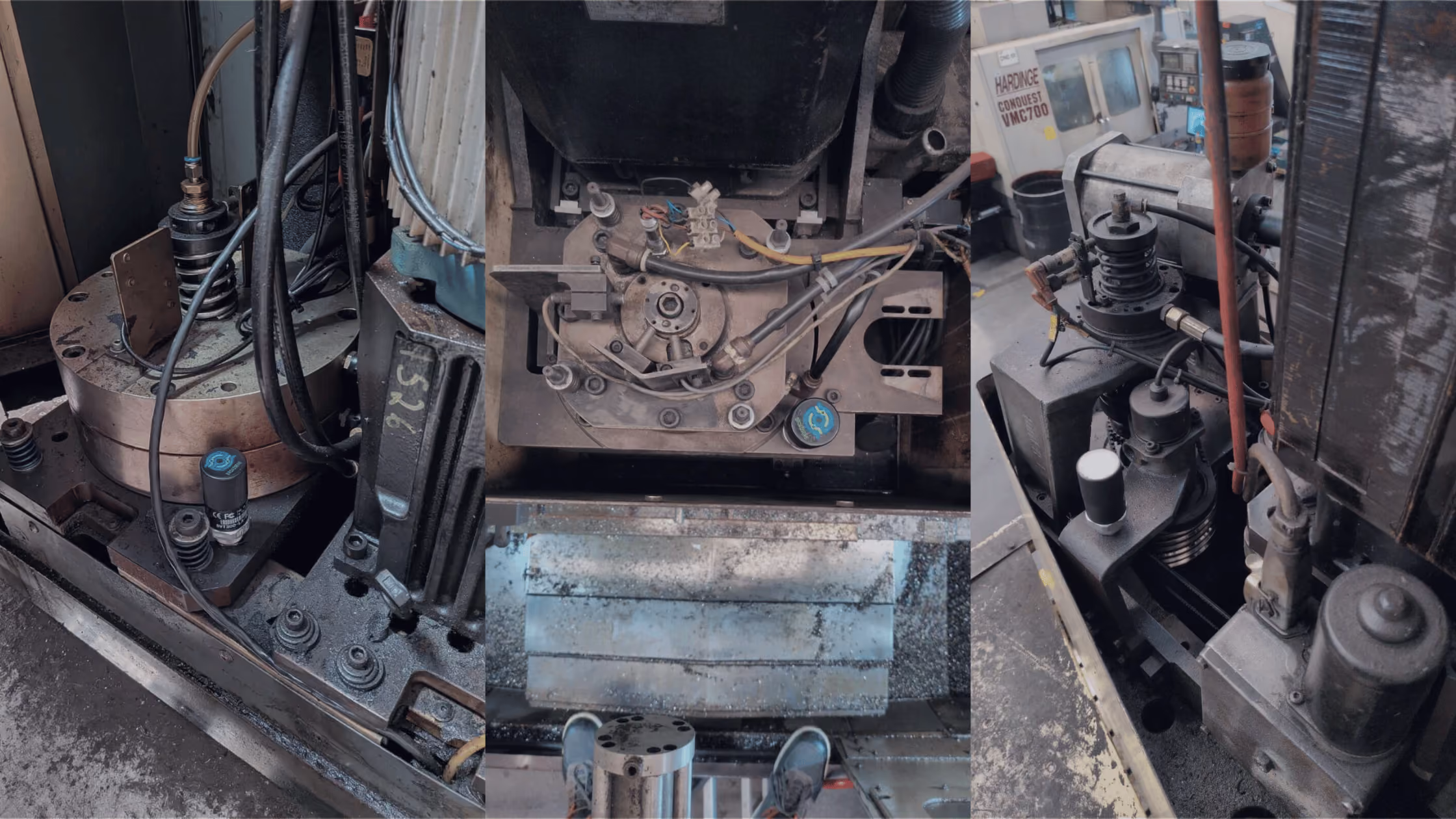
Install: Wireless vibration, temperature, and run-state sensors attach to machines in 60 seconds. No wiring, no IT involvement.
Learn: SensFlo’s AI establishes a baseline of normal operating behavior for each machine, accounting for shift patterns and production schedules.
Alert: When sensor data deviates from baseline in ways that predict impending failure, SensFlo sends an alert with recommended action.
Act: Maintenance is planned and executed before failure occurs, with full documentation in the platform.
SensFlo’s FloE AI assistant goes further: it answers natural language questions about machine health, maintenance history, and recommended actions — putting predictive maintenance insights in plain English for operators, not just engineers.
Combining Predictive and Preventive Maintenance: The Hybrid Approach
Most manufacturers don’t need to choose between predictive and preventive — they need a risk-based strategy that applies the right approach to the right equipment.
A practical framework:
Critical, high-value machines (injection molding presses, CNC job shops machining centers, bottleneck equipment): Full predictive monitoring with AI alerts.
Important but replaceable machines: Preventive schedule plus basic run-state monitoring.
Low-criticality, low-cost equipment (conveyors, fans, pumps): Reactive maintenance with basic condition monitoring for awareness.
Starting with predictive monitoring on your 5–10 most critical machines — which is a common deployment pattern with SensFlo — often delivers enough ROI in the first 90 days to justify expanding to the full floor.
SensFlo offers a 90-day money-back guarantee, allowing manufacturers to validate ROI on critical machines before committing to a full deployment.
Predictive Maintenance for Specific Machine Types
Injection Molding Presses
Key failure modes: hydraulic pump degradation, toggle pin wear, barrel heater failures, and tie bar issues. Vibration monitoring of the pump and hydraulic system, combined with thermal monitoring of the barrel zones, provides early warning for all of these.
CNC Machining Centers
Key failure modes: spindle bearing wear, axis ball screw degradation, coolant pump failure, and tool holder imbalance. High-frequency vibration monitoring of the spindle is the most critical measurement for CNC machines.
Stamping Presses
Key failure modes: flywheel bearing wear, clutch degradation, and die misalignment. Vibration during the press cycle and acoustic monitoring during the strike identify these early.
Getting Started with Predictive Maintenance
A predictive maintenance program doesn’t require a six-month implementation project. With modern sensor technology, you can have your first machines monitored and receiving AI-powered alerts within a day.
A recommended starting sequence:
Identify your 5 most critical (or most frequently failing) machines.
Install non-invasive sensors on each. With SensFlo, this takes under 5 minutes per machine.
Allow 2–4 weeks of baseline learning — the AI establishes normal behavior patterns.
Begin receiving predictive alerts and tracking maintenance actions.
After 90 days, measure: How many unplanned stops were caught early? What is the estimated downtime value saved?
Frequently Asked Questions
Q: What is the difference between predictive and preventive maintenance?
Preventive maintenance is performed on a fixed schedule (every 500 hours, every 3 months) regardless of machine condition. Predictive maintenance uses real-time sensor data to detect early signs of failure and schedules maintenance only when the data indicates it’s needed. Predictive maintenance reduces both unnecessary maintenance costs and unplanned downtime.
Q: How does predictive maintenance software work?
Predictive maintenance software uses sensors attached to machines to continuously collect data (vibration, temperature, power draw, cycle counts). Machine learning algorithms analyze this data to detect deviations from established baselines that indicate developing failure. When these patterns are detected, the system generates a maintenance alert before failure occurs.
Q: Is predictive maintenance only for large manufacturers?
Not anymore. Modern IoT-based solutions like SensFlo make predictive maintenance accessible to small and mid-sized manufacturers. Sensors install in 60 seconds with no IT integration required, and subscription pricing starts at $99/machine/month — making the technology accessible to any facility with production equipment worth protecting.
Q: What ROI can I expect from predictive maintenance?
Studies show predictive maintenance programs reduce unplanned downtime by 30–50% and cut maintenance costs by 10–25%. For most manufacturers, this translates to a 3–10x ROI within the first year of deployment.
Q: What machines are best suited for predictive maintenance?
Any machine where unplanned failure is costly is a good candidate. Priority machines include bottleneck equipment (failure stops the whole line), high-value assets, machines with history of unexpected failures, and equipment with long lead times for parts or repairs.
Related Reading
Ready to get started? Request a free demo— most manufacturers are monitoring their first machines within a week. Use the ROAI Calculator to project your return, or explore pricing to find the right tier for your operation. Learn more about our solutions, FloE AI, and customer success stories.
Frequently Asked Questions
What is the difference between predictive and preventive maintenance?
Preventive maintenance is scheduled on a fixed time interval. Predictive maintenance is triggered by the machine's actual monitored condition. For a full glossary of maintenance terms and concepts, see the Industrial AI & Machine Monitoring Glossary: 20 Essential Definitions.
Is predictive maintenance worth the investment for smaller manufacturers?
Yes. For how small manufacturers have achieved strong ROI with SensFlo, see the case studies on Axxis, COPP, and Miller CNC. Use SensFlo's ROAI Calculator to project your specific return.
What types of equipment failures are most predictable with sensor monitoring?
Bearing failures are the most predictable through vibration monitoring. For a deep dive into how vibration sensors detect bearing defects weeks before failure, see Optimizing Industrial Performance with SensFlo's Vibration Sensors.
How do you build a hybrid maintenance strategy that combines predictive and preventive approaches?
A practical hybrid applies condition-based monitoring to high-criticality equipment and retains PM schedules for lower-criticality assets. For how this applies in a specific industry context, see The Importance of Predictive Maintenance in Industry 4.0.
What sensor data is needed to enable predictive maintenance?
The minimum effective package is vibration and temperature monitoring at key bearing points. For how these sensors work, see vibration sensors, temperature monitoring, and power monitoring.


Talk to us
Let us take your company to the next level. Let’s have a chat and find out how we can help you.

